Evening vs Morning Wildlife Tours in Banff
Should you book an evening or morning wildlife tour in Banff? Both hit the dawn-and-dusk activity peak — here's what each offers, the tradeoffs, and how to choose the safari that suits you.
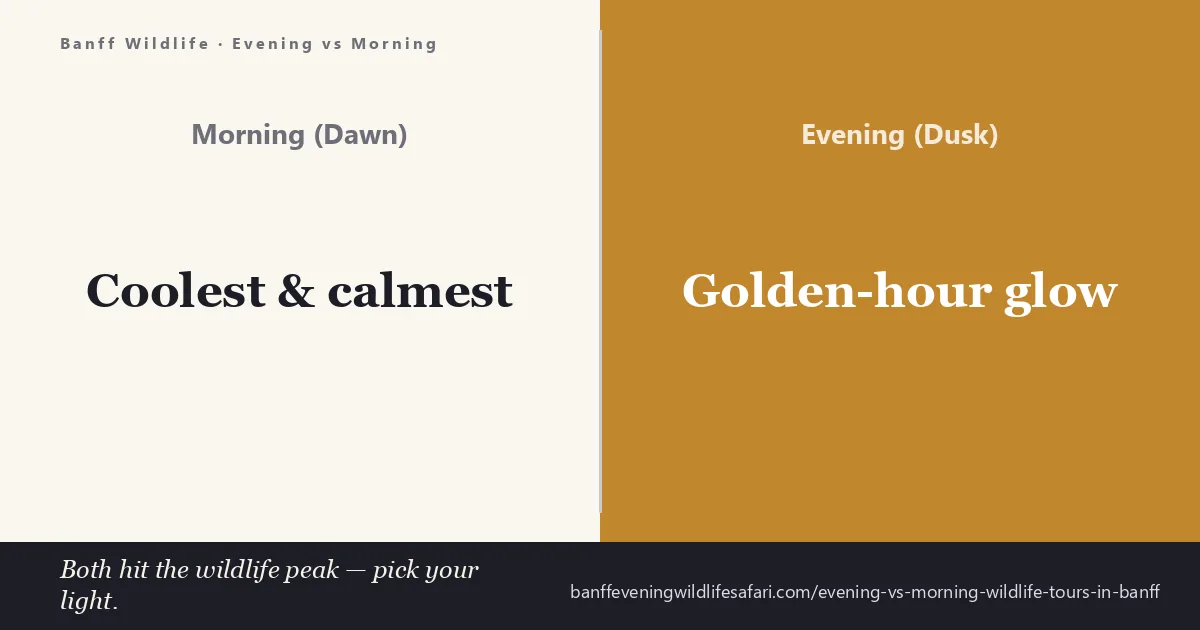
Here’s the reassuring part: there’s no wrong answer. Both morning and evening wildlife tours target the same thing — the twilight hours when Banff’s animals are most active — so either one beats a midday outing handily. The choice comes down to light, atmosphere, and your own rhythm. This guide lays out what each offers so you can pick with confidence.
Why Both Work
Most of Banff’s mammals are crepuscular, meaning they feed and move at dawn and dusk rather than in the middle of the day. That gives you two daily peak windows, and a well-run tour aims for the heart of one of them. Midday — especially a hot summer afternoon — is the weakest time to look, as animals bed down in shade and avoid busy roads. So the real decision isn’t whether to go at a peak hour, but which peak hour.
Morning vs Evening at a Glance
| Morning (dawn) | Evening (dusk) | |
|---|---|---|
| Light | Cool, soft, blue-to-gold | Warm golden hour, sunset glow |
| Crowds | Fewest people out | Quieter than midday |
| Animals | Fresh after the night, on the move | Emerging to feed before dark |
| Best for | Moose, elk, bears before the heat | Photography, lakes glowing, atmosphere |
| The catch | Very early wake-up | Competes with dinner; cooler after dark |
The Case for Evening
Dusk is the postcard window. As the sun drops, the Rockies catch alpenglow, the alpine lakes turn to glass and gold, and wildlife stirs in the cooling air — it’s the most photogenic time to be in the valley. Evening tours also tend to feel unhurried, and because the light is fading anyway, many naturally extend toward stargazing once the animals settle. If you want the version of Banff that looks like the brochure, with elk silhouetted against a burning sky, the evening is your hour. It’s why the dedicated twilight wildlife safari is built around this exact window.
The Case for Morning
Dawn is the purist’s window. It’s the coolest and calmest part of the day, with the fewest other people on the roads and animals fresh and active after the night. Early risers and serious photographers often swear by it — and in high summer, when afternoons turn hot, the morning can edge out the evening for sheer activity. The price of admission is a genuinely early alarm.
The One Honest Caveat
Whichever you choose, no tour can guarantee sightings. One operator reports seeing wildlife on roughly 95% of its evening safaris — a great rate, but a single company’s claim, and still explicitly not a promise. Banff is wild, animals are unpredictable, and that’s part of the deal. What a guided tour reliably gives you is the best possible odds: peak timing, a naturalist who knows where animals have been moving, and a trained spotter’s eye.
So, Which Should You Book?
- Choose evening if you want golden-hour light, sunset over the lakes, a relaxed pace, and maybe some stars. (Best in spring and fall; lovely year-round.)
- Choose morning if you’re an early riser, you’re chasing the calmest conditions, or you’re visiting in the heat of summer.
- Either way, go in the right season — the best time for wildlife viewing breaks down which months put the most animals on the roadside, and the species guide sets realistic expectations for what you’ll actually see.
Ready to Book?
Lean toward the magic hour? A top-rated small-group Banff evening wildlife safari times your outing for dusk — peak wildlife activity, golden light on the Rockies, and a local naturalist guide, with free cancellation up to 24 hours before. Check availability and pick your evening in the valley.
See Banff's Wildlife at Its Most Active — at Dusk
Skip the guesswork of self-driving at golden hour. This top-rated guided twilight safari times your outing for peak wildlife hours, with a local guide who knows where the animals move. Free cancellation up to 24 hours before.
Check Availability & Book